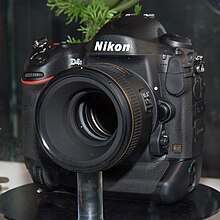
Digital SLR cameras, along with most other digital cameras, generally have a mode dial to access standard camera settings or automatic scene-mode settings. Sometimes called a "PASM" dial, they typically provide modes such as program, aperture-priority, shutter-priority, and full manual modes. Scene modes vary from camera to camera, and these modes are inherently less customizable. They often include landscape, portrait, action, macro, night, and silhouette, among others. However, these different settings and shooting styles that "scene" mode provides can be achieved by calibrating certain settings on the camera. Professional DSLRs seldom contain automatic scene modes as professionals often do not require these and professionals know how to achieve the looks they want.[citation needed]
In general, HDSLRs use the full imager area to capture HD video, though not all pixels (causing video artifacts to some degree). Compared with the much smaller image sensors found in the typical camcorder, the HDSLR's much larger sensor yields distinctly different image characteristics.[4] HDSLRs can achieve much shallower depth of field and superior low-light performance. However, the low ratio of active pixels (to total pixels) is more susceptible to aliasing artifacts (such as moire patterns) in scenes with particular textures, and CMOS rolling shutter tends to be more severe. Furthermore, due to the DSLR's optical construction, HDSLRs typically lack one or more video functions found on standard dedicated camcorders, such as autofocus while shooting, powered zoom, and an electronic viewfinder/preview. These and other handling limitations prevent the HDSLR from being operated as a simple point-and-shoot camcorder, instead demanding some level of planning and skill for location shooting.
In 2000, Olympus introduced the Olympus E-10, the first DSLR with live preview – albeit with an atypical fixed lens design. In late 2008, some DSLRs from Canon, Nikon, Olympus, Panasonic, Leica, Pentax, Samsung and Sony all provided continuous live preview as an option. Additionally, the Fujifilm FinePix S5 Pro[9] offers 30 seconds of live preview.
"Full-frame" is the same size as 35 mm film (135 film, image format 24×36 mm); these sensors are used in DSLRs such as the Canon EOS-1D X Mark II, 5DS/5DSR, 5D Mark IV and 6D Mark II, and the Nikon D5, D850, D750, D610 and Df. Most modern DSLRs use a smaller sensor that is APS-C sized, which is approximately 22×15 mm, slightly smaller than the size of an APS-C film frame, or about 40% of the area of a full-frame sensor. Other sensor sizes found in DSLRs include the Four Thirds System sensor at 26% of full frame, APS-H sensors (used, for example, in the Canon EOS-1D Mark III) at around 61% of full frame, and the original Foveon X3 sensor at 33% of full frame (although Foveon sensors since 2013 have been APS-C sized). Leica offers an "S-System" DSLR with a 30×45 mm array containing 37 million pixels.[11] This sensor is 56% larger than a full-frame sensor.
The angle of view of a lens depends upon its focal length and the camera's image sensor size; a sensor smaller than 35 mm film format (36×24 mm frame) gives a narrower angle of view for a lens of a given focal length than a camera equipped with a full-frame (35 mm) sensor. As of 2017, only a few current DSLRs have full-frame sensors, including the Canon EOS-1D X Mark II, EOS 5D Mark IV, EOS 5DS/5DS R, and EOS 6D Mark II; Nikon's D5, D610, D750, D850, and Df; and the Pentax K-1. The scarcity of full-frame DSLRs is partly a result of the cost of such large sensors. Medium format size sensors, such as those used in the Mamiya ZD among others, are even larger than full-frame (35 mm) sensors, and capable of even greater resolution, and are correspondingly more expensive.
Over the next decade, other camera manufacturers entered the DSLR market, including Canon, Kodak, Fujifilm, Minolta (later Konica Minolta, and ultimately acquired by Sony), Pentax (whose camera division is now owned by Ricoh), Olympus, Panasonic, Samsung, Sigma, and Sony.
Currently DSLRs are widely used by consumers and professional still photographers. Well established DSLRs currently offer a larger variety of dedicated lenses and other photography equipment. Mainstream DSLRs (in full-frame or smaller image sensor format) are produced by Canon, Nikon, Pentax, and Sigma. Pentax, Phase One, Hasselblad, and Mamiya Leaf produce expensive, high-end medium-format DSLRs, including some with removable sensor backs. Contax, Fujifilm, Kodak, Panasonic, Olympus, Samsung previously produced DSLRs, but now either offer non-DSLR systems or have left the camera market entirely. Konica Minolta's line of DSLRs was purchased by Sony.
- Canon's current 2018 EOS digital line includes the Canon EOS 1300D/Rebel T6, 200D/SL2, 800D/T7i, 77D, 80D, 7D Mark II, 6D Mark II, 5D Mark IV, 5Ds and 5Ds R and the 1D X Mark II. All Canon DSLRs with three- and four-digit model numbers, as well as the 7D Mark II, have APS-C sensors. The 6D, 5D series, and 1D X are full-frame. As of 2018, all current Canon DSLRs use CMOS sensors.
- Nikon has a broad line of DSLRs, most in direct competition with Canon's offerings, including the D3400, D5600, D7500 and D500 with APS-C sensors, and the D610, D750, D850, D5, D3X and the Df with full-frame sensors.
- Leica produces the S2, a medium format DSLR.
- Pentax currently offers the K-3 II, K-S2 and K-S1, all of which use an APS-C sensor.[37] These models offer extensive backwards compatibility, accepting all Pentax K mount lenses, which started being made in 1975. Pentax also offers the Pentax 645Z, which is a medium format camera, and, like Pentax' medium format film cameras, compatible with Pentax' 645 system lenses. In 2016, Pentax introduced its first full-frame DSLR, the Pentax K-1, with the successor K-1 Mark II announced in 2018.
- Sigma produces DSLRs using the Foveon X3 sensor, rather than the conventional Bayer sensor. This is claimed to give higher colour resolution, although headline pixel counts are lower than conventional Bayer-sensor cameras. It currently offers the entry-level SD15 and the professional SD1. Sigma is the only DSLR manufacturer which sells lenses for other brands' lens mounts.
- Sony has modified the DSLR formula in favor of single-lens translucent (SLT) cameras,[38] which are still technically DSLRs, but feature a fixed mirror that allows most light through to the sensor while reflecting some light to the autofocus sensor. Sony's SLTs feature full-time phase detection autofocus during video recording as well as continuous shooting of up to 12 frame/s. The α series, whether traditional SLRs or SLTs, offers in-body sensor-shift image stabilization and retains the Minolta AF lens mount. As of July 2017, the lineup included the Alpha 68, the semipro Alpha 77 II, and the professional full-frame Alpha 99 II. The translucent (transmissive) fixed mirror allows 70 percent of the light to pass through onto the imaging sensor, meaning a 1/3rd stop loss light, but the rest of this light is continuously reflected onto the camera's phase detection AF sensor for fast autofocus for both the viewfinder and live view on the rear screen, even during video and continuous shooting. The reduced number of moving parts also makes for faster shooting speeds for its class. This arrangement means that the SLT cameras use an electronic viewfinder as opposed to an optical viewfinder, which some consider a disadvantage, but does have the advantage of a live preview of the shot with current settings, anything displayed on the rear screen is displayed on the viewfinder, and handles bright situations well.[39]
The larger, advanced digital cameras offer a non-optical electronic through-the-lens (TTL) view, via an eye-level electronic viewfinder (EVF) in addition to the rear LCD. The difference in view compared with a DSLR is that the EVF shows a digitally created image, whereas the viewfinder in a DSLR shows an actual optical image via the reflex viewing system. An EVF image has lag time (that is, it reacts with a delay to view changes) and has a lower resolution than an optical viewfinder but achieves parallax-free viewing using less bulk and mechanical complexity than a DSLR with its reflex viewing system. Optical viewfinders tend to be more comfortable and efficient, especially for action photography and in low-light conditions. Compared with digital cameras with LCD electronic viewfinders, there is no time lag in the image: it is always correct as it is being "updated" at the speed of light. This is important for action or sports photography, or any other situation where the subject or the camera is moving quickly. Furthermore, the "resolution" of the viewed image is much better than that provided by an LCD or an electronic viewfinder, which can be important if manual focusing is desired for precise focusing, as would be the case in macro photographyand "micro-photography" (with a microscope). An optical viewfinder may also cause less eye-strain. However, electronic viewfinders may provide a brighter display in low light situations, as the picture can be electronically amplified.
For a long time, DSLRs offered faster and more responsive performance, with less shutter lag, faster autofocus systems, and higher frame rates. Around 2016-17, specific mirrorless camera models started offering competitive or superior specifications in these aspects. The downside of these cameras being that they do not have an optical viewfinder, making it difficult to focus on moving subjects or in situations where a fast burst mode would be beneficial. Other digital cameras were once significantly slower in image capture (time measured from pressing the shutter release to the writing of the digital image to the storage medium) than DSLR cameras, but this situation is changing with the introduction of faster capture memory cards and faster in-camera processing chips. Still, compact digital cameras are not suited for action, wildlife, sports and other photography requiring a high burst rate (frames per second).
The sensors used in current DSLRs ("Full-frame" which is the same size as 35 mm film (135 film, image format 24×36 mm), APS-C sized, which is approximately 22×15 mm, and Four Thirds System) are typically much larger than the sensors found in other types of digital cameras. Entry-level compact cameras typically use sensors known as 1/2.5″, which is 3% the size of a full frame sensor. There are bridge cameras (also known as premium compact cameras or enthusiast point-and-shoot cameras) that offer sensors larger than 1/2.5″ but most still fall short of the larger sizes widely found on DSLR. Examples include the Sigma DP1, which uses a Foveon X3 sensor; the Leica X1; the Canon PowerShot G1 X, which uses a 1.5″ (18.7×14 mm) sensor that is slightly larger than the Four Thirds standard and is 30% of a full-frame sensor; the Nikon Coolpix A, which uses an APS-C sensor of the same size as those found in the company's DX-format DSLRs; and two models from Sony, the RX100 with a 1″-type (13.2×8.8 mm) sensor with about half the area of Four Thirds and the full-frame Sony RX1. These premium compacts are often comparable to entry-level DSLRs in price, with the smaller size and weight being a tradeoff for the smaller sensor.
Panasonic released the first Micro Four Thirds camera, the Lumix DMC-G1. Several manufacturers have announced lenses for the new Micro Four Thirds mount, while older Four Thirds lenses can be mounted with an adapter (a mechanical spacer with front and rear electrical connectors and its own internal firmware). A similar mirror-less interchangeable lens camera, but with an APS-C-sized sensor, was announced in January 2010: the Samsung NX10. On 21 September 2011, Nikon announced with the Nikon 1 a series of high-speedMILCs. A handful of rangefinder cameras also support interchangeable lenses. Six digital rangefinders exist: the Epson R-D1 (APS-C-sized sensor), the Leica M8 (APS-H-sized sensor), both smaller than 35 mm film rangefinder cameras, and the Leica M9, M9-P, M Monochrom and M (all full-frame cameras, with the Monochrom shooting exclusively in black-and-white).